
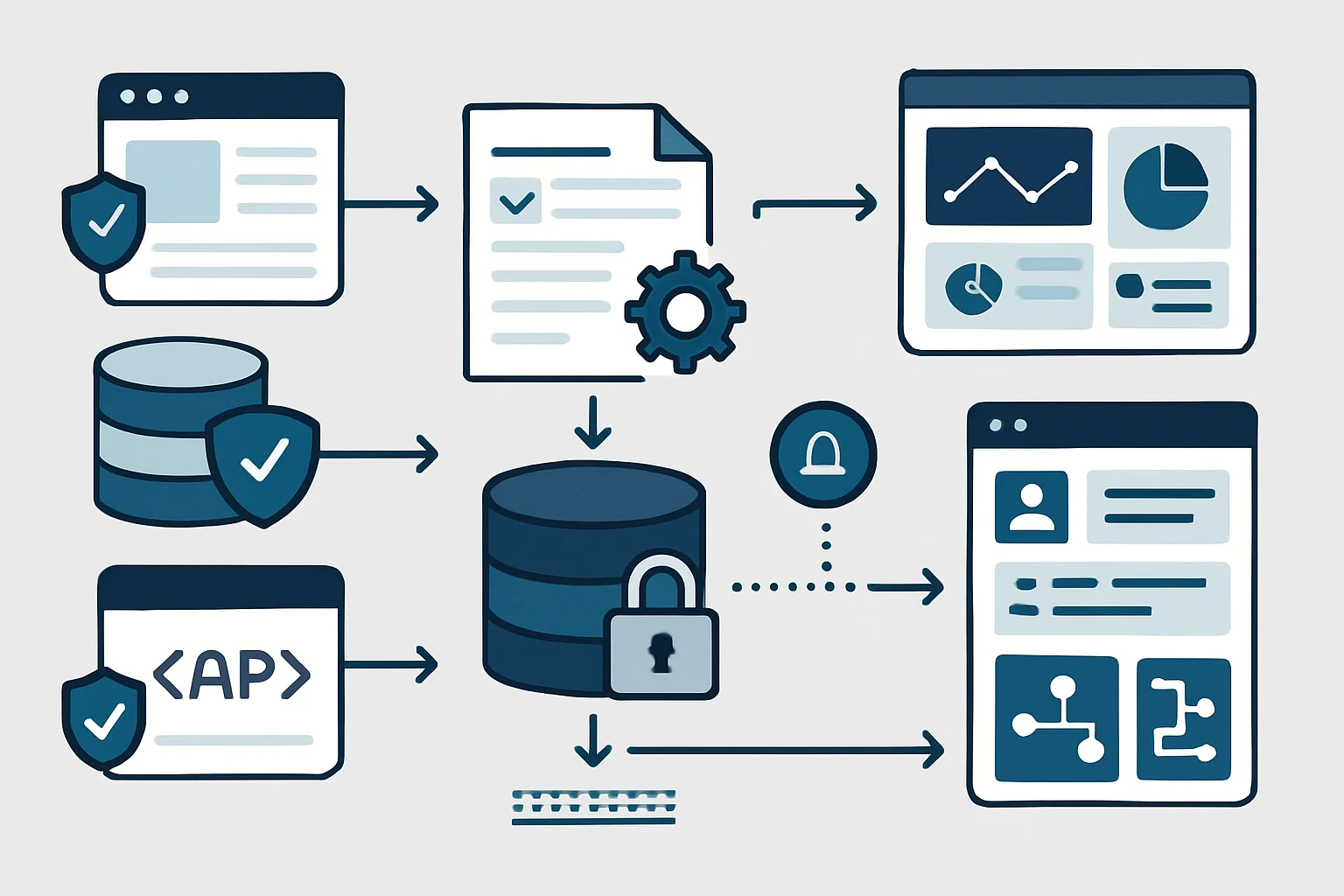
Web scraping and data collection automation services can turn permitted online information into a repeatable input for research, procurement, market monitoring, and reporting. However, copying page text is rarely the difficult part. Specifically, a dependable approach establishes which sources may be used, what information is needed, how often it should refresh, and how inaccurate or duplicate records will be handled.
Moreover, when collection supports a business process, data should enter systems people already use rather than remain in an isolated file. That may involve data orchestration services for controlled movement and storage, or custom software development for a tailored review process. Consequently, web scraping and data collection automation services work best as an owned operational capability, not a one-off extraction.
Key Takeaways
- Permission comes first
A public page is not automatically an approved data source. Therefore, review terms, access conditions, privacy obligations, and technical restrictions before designing collection.
- Quality needs controls
Validation, duplicate matching, source timestamps, and exception queues make collected information easier to trust. In turn, those controls support safer downstream use.
- Maintenance is part of delivery
Pages, feeds, formats, and policies change. Consequently, monitoring and clear ownership should be designed before a collection workflow enters routine use.
- Data needs a destination
The strongest use cases connect approved, checked data to a report, CRM, internal database, or owned review process. In other words, every collected field needs a defined business purpose.
What Web Scraping and Data Collection Automation Services Include
A useful service designs the complete collection process, not simply a one-time extraction.
In practice, web scraping and data collection automation services create a controlled way to gather defined information from approved online sources for a business purpose. The method may use an official API, public dataset, authorized feed, browser-based collection, or a custom application that reads permitted pages. However, the right choice depends on source rules, format, refresh needs, and intended use.
Accordingly, collection is only one stage. A practical workflow records the source and retrieval time, standardizes formats, checks required fields, identifies likely duplicates, and routes uncertain records to review. For example, a procurement team may need product names, availability, published prices, source links, and timestamps rather than every displayed field.
Start a Web Data Collection Automation Brief
A clear question prevents unnecessary collection and makes controls easier to design. For instance, a team might ask which approved suppliers publish a category or which competitor pages changed this week. Once agreed, the team can define minimum fields, retention, refresh timing, ownership, and destination. Consequently, the data supports a decision instead of creating another unmanaged spreadsheet.
Business Uses for Web Data Collection Automation
Web scraping and data collection automation services are most valuable when they support a repeated decision or operational task with clear ownership.
Market Intelligence Monitoring
Meanwhile, research teams may revisit approved public sources to identify competitor changes, published announcements, or market activity.
In practice, a scheduled process can capture defined fields, compare them with prior records, and route meaningful changes into a review list or research brief.
- More consistent source coverage
- Visible change history
- Less repetitive page checking
Procurement Source Research
Procurement staff may compare supplier catalogue details, public tender notices, availability information, or compliance statements across permitted sources.
A tailored workflow can collect approved fields, normalize units and names where appropriate, flag incomplete entries, and prepare a structured comparison for human evaluation.
- More reusable research records
- Clearer source references
- Reduced manual transcription
E-Commerce Catalogue Checks
E-commerce operators may need to track changes in permitted competitor listings, availability, descriptions, or publicly published pricing.
A collection job can retrieve scoped data at an agreed cadence, validate fields, identify changes, and deliver an exception list. As a result, staff need not compare every page manually.
- Timelier review signals
- Consistent comparison fields
- An auditable collection record
Web Data Collection Automation Methods: APIs, Feeds, and Research
For web scraping and data collection automation services, the least fragile and most clearly authorized option is usually the best starting point.
Official API
- Best suited to
- Sources that provide documented programmatic access
- Primary advantage
- Clearer structure, supported fields, and more predictable integration
- Important consideration
- Therefore, confirm authentication, usage limits, permissions, and change-notice practices.
Public data feed or download
- Best suited to
- Published datasets, open data portals, CSV files, XML feeds, or released reports
- Primary advantage
- Often simpler to validate and retain with source metadata
- Important consideration
- Check release timing, licensing, schema changes, and whether the feed is authoritative.
Permitted web-page collection
- Best suited to
- Defined public pages where collection is allowed and no suitable feed is available
- Primary advantage
- Can capture specific published information needed by a business process
- Important consideration
- However, page structures can change; respect source terms, technical limits, and privacy boundaries.
Manual research
- Best suited to
- Low-volume, high-judgement tasks or sources unsuitable for automated access
- Primary advantage
- Human context is retained for nuanced evaluation
- Important consideration
- Use a structured template so findings can still be reviewed and reused.
Responsible Web Scraping and Data Collection Automation Services
Responsible collection is a design requirement, not an afterthought.
Responsible web scraping starts with a source review. Browser access alone does not establish that automated collection, reuse, or commercial use is permitted. Therefore, identify the source owner, review applicable terms and access policies, determine whether an official API or feed is available, and record the intended use before building a workflow.
Technical signals such as robots.txt can communicate crawler preferences, but they do not replace terms, permissions, contractual conditions, or legal obligations. Similarly, a workflow should not bypass access controls, logins, CAPTCHAs, rate limits, paywalls, or other restrictions. If access is unclear, seek permission, use an approved alternative, or retain human research.
Privacy in Responsible Web Scraping
Where a source includes personal information, consider whether it is necessary, which policy or lawful basis applies, who can access it, how long it should be retained, and whether it will move to another system. In particular, sensitive, confidential, or high-risk data should not enter a general-purpose spreadsheet by default. Instead, involve relevant privacy, legal, security, or compliance stakeholders.
Respectful Web Scraping Protects Source Reliability
Even where collection is approved, use sensible request frequency, avoid unnecessary repeat retrieval, and preserve source attribution. In addition, retain source URLs, collection time, method, and relevant approvals. These details, in turn, help teams investigate discrepancies and reassess workflows if source rules change.
Quality Controls for Web Data Collection Automation
Web scraping and data collection automation services need quality checks between collection and downstream use.
Validate Required Fields
Consequently, check that expected fields are present and plausible before a record reaches a report or operational system. A comparison record may require a source URL, collection timestamp, product name, and recognized identifier or category.
- Required-field checks
- Format and range rules
Match Likely Duplicates
The same item can appear under slightly different names, URLs, or source formats. Therefore, use agreed matching rules based on stable identifiers where possible, then route uncertain matches for review.
- Identifier-based matching
- Human review for uncertainty
Detect Meaningful Changes
A useful monitoring process compares selected current values with a prior approved snapshot. It should, however, distinguish a relevant change from a formatting difference or temporary collection failure.
- Field-level comparisons
- Exception-based alerts
Preserve Source Context
Keep source links, retrieval timestamps, source names, and original captured values where appropriate. Consequently, reviewers can investigate where a figure or statement came from rather than rely on a detached summary.
- Source attribution
- Collection timestamps
Use an Exception Queue
As a result, records with missing fields, unexpected formats, duplicate uncertainty, or large changes should enter an owned review queue. This prevents questionable data from silently flowing into a CRM, dashboard, or customer-facing decision.
- Named reviewer
- Recorded resolution
Retain Useful History
A history of validated records can support trend analysis and explain why a later report changed. However, retention should remain proportionate to the purpose, source conditions, privacy requirements, and internal policy.
- Versioned snapshots
- Defined retention rules
Web scraping and data collection automation services require controls from an approved source to a business output.
- Approved Sources Permitted public pages, official APIs, and published feeds are documented in a source register.
- Collection Jobs Scheduled or event-based jobs retrieve only defined fields at an appropriate frequency.
- Normalization Next, values are standardized into consistent names, dates, units, and reference formats.
- Quality Controls Then, validation, duplicate checks, and change rules identify records needing attention.
- Structured Storage Validated data and source context are stored in an appropriate controlled location.
- Business Outputs Finally, approved records support reports, review queues, CRM updates, or internal applications.
Maintaining Automated Web Data Collection
A collection process should be monitored like an operational system because sources and business needs evolve.
Meanwhile, web sources are not static. A publisher may alter page structure, rename a field, move data, release a new API version, or change access terms. As a result, a workflow can begin returning incomplete data, unexpected values, or no records. Web scraping and data collection automation services should therefore include monitoring and a maintenance route from the outset.
Useful monitoring is specific. It can compare record counts with a normal range, identify missing values, detect an unexpected response, or flag an unusually large field change. However, an alert alone is insufficient. Business and technical owners must assess the issue, pause downstream updates if necessary, and decide whether a source rule or collection method should change.
Separate Web Data Collection Failures from Business Changes
A sharp change may be a valid market event, a source update, or a broken collection rule. Consequently, keeping source context and validation outcomes helps reviewers tell the difference. This matters when data informs pricing research, supplier selection, compliance monitoring, or management reporting.
A Web Data Collection Automation Maintenance Workflow
Use a repeatable response path when a source, schema, or business rule changes.
- 1
Record the Source Baseline
First, capture the approved source, expected fields, normal volume, access method, refresh schedule, and permission notes.
Documented source baseline - 2
Monitor Collection Health
Then, track job completion, source responses, record counts, required-field failures, duplicate rates, and change volumes against expectations.
Health and exception signals - 3
Pause Unsafe Downstream Updates
When a material anomaly occurs, prevent questionable records from updating reports or business systems until assessment under the agreed rule.
Protected downstream process - 4
Diagnose the Cause
Next, review the source, captured values, validation results, recent schema changes, credentials where applicable, and collection configuration.
Issue classification - 5
Test and Release the Update
Finally, update the rule, mapping, or approved approach; test normal and exception cases; record the change; and resume controlled collection.
Verified maintenance release
Moving Web Data Collection Automation into Business Systems
Web scraping and data collection automation services should send information to the business destination that matches its decision, sensitivity, and required level of review.
Reports and Research Views
Validated web data can feed a controlled dataset for reports, market-monitoring views, procurement comparisons, or exception summaries. In addition, outputs should show collection date, source coverage, and unresolved exceptions so decision-makers understand context.
- Trend and change analysis
- Source-backed review records
- Exception-aware reporting
CRMs and Internal Applications
Where a process needs data operationally, approved records may populate a research queue, supplier profile, product reference table, or internal application. In contrast, sensitive, uncertain, or high-impact updates should remain reviewable before overwriting an authoritative record.
- Controlled record enrichment
- Review before important updates
- Clear system-of-record rules
Planning Web Data Collection Automation
A discovery phase should establish operational rules, not just technical requirements.
Before implementation, map the current research or monitoring activity in enough detail for informed design. Consequently, identify the source list, purpose, required fields, expected volume, refresh needs, allowed access method, review points, destination system, and exception owners. This helps determine whether an API integration, feed ingestion process, permitted page collection, low-code workflow, custom application, or combination is suitable.
In addition, web scraping and data collection automation services should follow the operating need. For instance, a small internal monitoring process may work with scheduled cloud automation and a controlled data store. Conversely, a high-volume process with complex parsing, source-specific rules, detailed monitoring, and several integrations may need custom development and formal support. The choice also depends on security, licensing, maintainability, scalability, and budget.
Web Data Collection Automation and Human Judgement
Automation can prepare, compare, and route information. It should not, however, silently make legal, financial, privacy, contractual, or exceptional decisions requiring contextual judgement. Therefore, define which events are safe to process automatically, which require confirmation, and who can resolve an exception.
Web Data Collection Automation Readiness Checklist
Use this checklist before approving web scraping and data collection automation services or expanding a pilot.
- Approved source list
Therefore, each source has an owner, documented purpose, appropriate access method, and a recorded review of permissions or applicable terms.
- Minimum data definition
The business has agreed which fields are necessary, how records are identified, and which values require human interpretation.
- Quality and exception rules
Required-field checks, duplicate logic, change thresholds, review queues, and downstream pause conditions are defined.
- Destination and ownership
The receiving report, CRM, database, or application is known, with named business and technical owners for ongoing operation.
- Security and retention controls
In addition, access, storage location, audit needs, retention period, and personal-data handling have been assessed for the intended use.
- Maintenance approach
The team has monitoring signals, a source-change response path, testing expectations, and change documentation for future updates.
Reliable Web Data Collection Automation Services
Responsible design makes collected information more useful over time.
Responsible web scraping and data collection automation services treat online information as an operational input needing boundaries, quality controls, ownership, and maintenance. Ultimately, useful solutions start with approved sources and a specific business question, then validate and preserve context before data reaches a report or internal system. As sources and requirements evolve, monitoring and review keep the workflow dependable. In other words, the goal is a proportionate, traceable flow of information that supports better decisions.
Web Data Collection Automation FAQs
Answers to practical questions businesses should consider before automating collection.
The answer depends on the source, information collected, access method, applicable terms, privacy requirements, intellectual property considerations, and relevant laws. Public visibility alone does not confirm that automated collection or reuse is allowed. Therefore, review source conditions and involve appropriate legal, privacy, or compliance stakeholders where the use case carries meaningful risk.
An API is an interface intentionally provided for software to request defined data or perform approved actions. Web scraping generally means collecting information displayed in web pages. In practice, when an official API or published feed meets the need and its terms allow the intended use, it is often more structured and easier to maintain than page-based collection.
The right cadence depends on how quickly the source changes, how urgently the business needs updates, source conditions, and the cost of acting on stale information. A daily, weekly, or event-based schedule may be appropriate in different cases. However, more frequent collection is not automatically better and can create unnecessary load, duplicate data, and review work.
Start with the most stable identifier available, such as a source-specific ID, canonical URL, or documented combination of fields. Then use matching rules for likely duplicates and route ambiguous cases to a reviewer. Automated merging should be limited when a mistaken match could affect an important business record or decision.
It can, provided the source, permissions, data quality, and system-of-record rules support that use. A safer design often sends new or changed data to a review queue first, particularly when it may overwrite an existing CRM record, affect a customer interaction, or introduce personal or commercially sensitive information.
Source pages, file formats, APIs, access policies, and business data requirements can change. Consequently, without monitoring, a process may continue running while returning incomplete or misleading results. Maintenance planning gives the business a way to detect anomalies, investigate the cause, test updates, and preserve confidence in downstream reports or systems.
Need Help Building a Responsible Data Collection Workflow?
Start with the business decision, approved sources, and controls your team needs.
JiyanaTech can assess your current web scraping and data collection services process and design a maintainable automation solution around your systems, controls, integrations, security and support needs.
Discuss This Workflow