
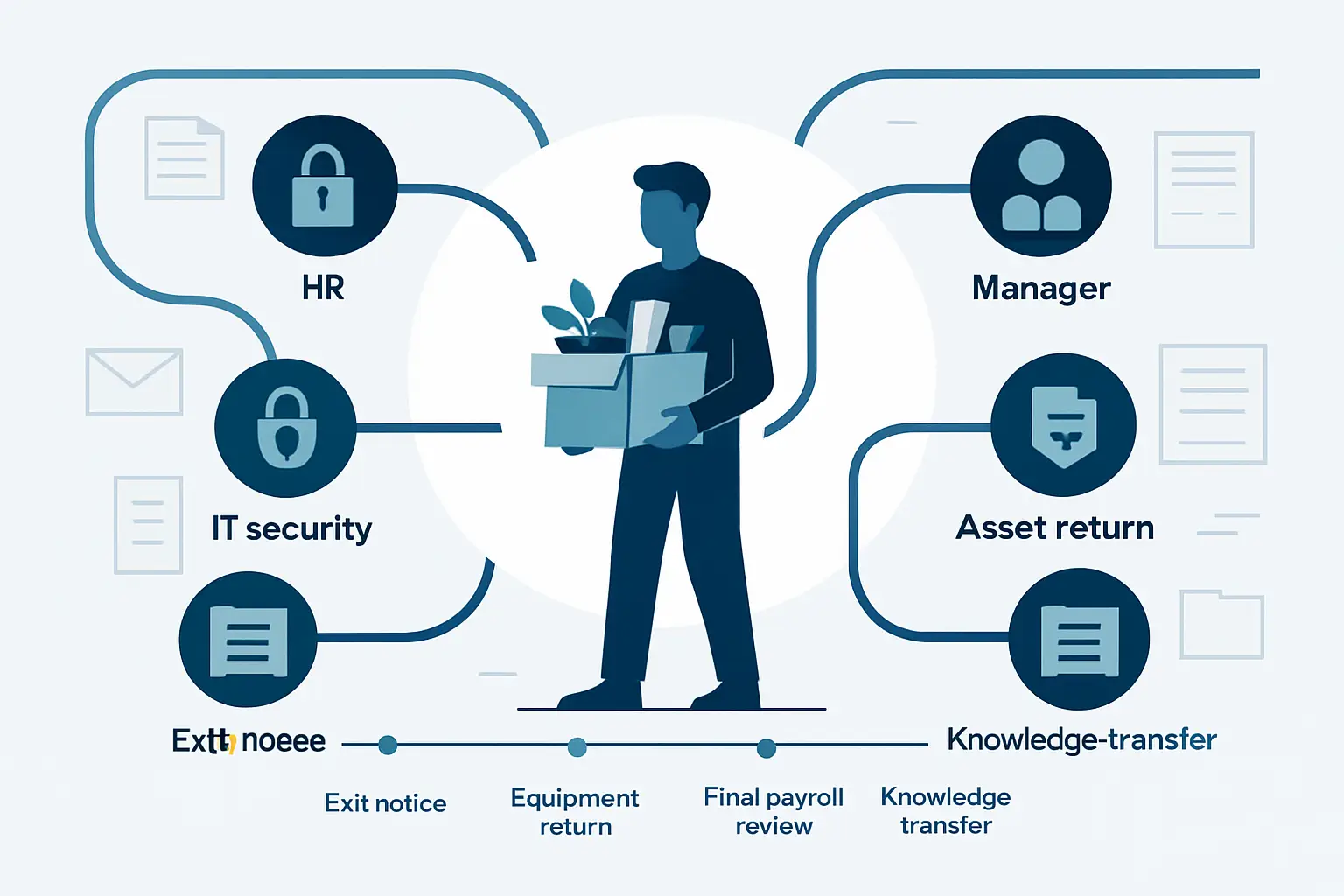
An employee offboarding solution is not simply a checklist for returning a laptop. Instead, it is a controlled process for managing the security, payroll, records, asset, and knowledge-transfer responsibilities created when someone leaves an organization. Therefore, when departments work from separate emails and spreadsheets, critical tasks can be delayed, duplicated, or left without evidence of completion.
A coordinated workflow gives HR, managers, IT, payroll, and compliance teams a shared view of what must happen, when it must happen, and who is accountable. Moreover, a well-designed employee offboarding solution complements employee onboarding automation by managing the other end of the employee lifecycle. For organizations assessing a broader approach, workflow automation consulting can help map responsibilities and connect the systems already in use.
Key Takeaways
- Start with a verified trigger
Use an approved resignation, termination, contract-end, or internal-transfer event to create the offboarding case and avoid acting on incomplete information.
- Assign every control owner
HR, IT, payroll, managers, facilities, legal, and security should receive specific tasks with due dates rather than a shared, unowned checklist.
- Separate automation from judgement
Automation can route tasks, notify owners, collect evidence, and revoke routine access, while exceptional security, legal, and payment decisions remain human-reviewed.
- Preserve completion evidence
A reliable process records timestamps, approvals, exceptions, asset acknowledgements, and retention decisions so the organization can verify what occurred.
Why a Manual Employee Offboarding Workflow Creates Security and Compliance Gaps
A departing employee affects several business systems and control areas at the same time, so disconnected handoffs can create avoidable exposure. An employee offboarding solution gives those teams a controlled shared record instead of a chain of unverified messages.
Late Access Removal
A manager informs HR; however, IT receives the notice after the employee’s final working time or through an overlooked email.
Therefore, create a time-bound IT task from an approved exit event, route it to the correct access owners, and record completion timestamps.
- Clear revocation deadline
- Escalation for overdue tasks
- Evidence for review
Untracked Company Assets
Meanwhile, laptops, badges, mobile devices, tokens, records, and keys may be tracked in different places or not recorded at all.
Generate an employee-specific asset list from the asset register, assign return instructions, and collect receipt or exception evidence.
- Item-level accountability
- Earlier exception visibility
- Consistent return records
Missing Exit Evidence
Teams may state that tasks were done without retaining the approval, timestamp, exception rationale, or supporting documentation.
Consequently, store task completion, acknowledgements, approvals, and exception notes in the offboarding case record.
- Auditable activity history
- Faster internal review
- More reliable records
The workflow should coordinate departmental actions without assuming that one team owns every decision or sees unnecessary employee data.
- HR Exit Record First, HR confirms the exit type, planned final date, manager, location, employment status, and any applicable policy path.
- Manager Handoff Meanwhile, the manager identifies work-transfer needs, customer or project handovers, delegated approvals, and team communication requirements.
- IT Access Gate IT then receives a role-aware access list and a trigger for scheduled removal, suspension, or review of non-standard accounts.
- Payroll Review Similarly, payroll validates final-pay inputs, accrued balances, deductions, reimbursement status, and jurisdiction-specific requirements.
- Assets and Facilities In addition, facilities or asset owners confirm return, collection, replacement, loss, or approved exception handling for physical property.
- Evidence Archive Finally, the workflow retains completion evidence, approvals, exceptions, and a retention classification for the closed exit record.
Employee Offboarding Solution: From Exit Notice to Closure
A practical employee offboarding solution begins with a verified event and ends only when accountable owners close or document every required action.
- 1
Confirm the exit event
First, an authorized HR representative records the departure type, final working date, effective termination date where relevant, manager, legal entity, work location, and whether the worker is an employee, contractor, or temporary staff member. The employee offboarding solution should validate required fields before creating downstream actions.
Approved offboarding case with a trusted effective date - 2
Classify the risk and route tasks
Next, apply rules for role, system access, location, employment type, business unit, and exit reason. For example, a privileged administrator, finance approver, or regulated-role employee may require an accelerated security review or additional evidence before the case proceeds.
Role-based task plan and escalation path - 3
Prepare the business handover
Meanwhile, the manager confirms ownership transfers for projects, customer relationships, shared mailboxes, delegated approvals, recurring meetings, records, and critical operational knowledge. The goal is to identify essential continuity actions rather than create an unchecked request for every possible document.
Documented handover plan with named recipients - 4
Execute timed access actions
At the approved trigger time, the process can initiate routine identity, application, collaboration, VPN, device, and badge tasks. However, unusual accounts, legal holds, break-glass access, and security incidents should be reviewed by authorized personnel before irreversible changes are made.
Access action log and exception queue - 5
Complete financial and asset tasks
In turn, payroll, finance, facilities, and asset owners complete final-pay inputs, expense checks, equipment return steps, procurement notifications, and any approved deductions or exceptions. Each owner should confirm completion against the specific exit case rather than through a general inbox response.
Asset and payment task evidence - 6
Review, close, and retain
Finally, a designated case owner checks that mandatory tasks are complete and that overdue tasks have documented resolutions. The system then closes the case while preserving a controlled audit trail according to the organization’s policy and applicable requirements.
Closed offboarding record with retained evidence
Employee Exit Management System Controls for Access, Assets, and Records
These controls should be designed together because an incomplete exit in one area can weaken the others. An employee offboarding solution should also keep their evidence connected to the same governed exit case.
Identity and application access
- Automated action
- Create access-removal tasks from the approved exit date and role profile; notify accountable application owners.
- Human decision or review
- Review privileged, shared, emergency, and legally retained accounts before changing access.
- Completion evidence
- Task timestamp, owner confirmation, exception reason, and system action reference.
Devices and physical assets
- Automated action
- Build a return list from asset records and send location-appropriate instructions or collection tasks.
- Human decision or review
- Approve loss, delayed return, replacement, disposal, or recovery exceptions under the relevant policy.
- Completion evidence
- Returned-item receipt, condition note, tracking reference, or approved exception.
Records and business data
- Automated action
- Assign mailbox, file, document, and work-record transfer tasks based on the employee's role and policy rules.
- Human decision or review
- Determine legal hold, investigation, customer obligation, or privacy requirements before deletion or transfer.
- Completion evidence
- Transfer acknowledgement, retention classification, and authorized decision record.
Payroll and benefits
- Automated action
- Route final-pay, benefits, expense, and tax-related tasks to the correct payroll or benefits owner.
- Human decision or review
- Validate final amounts, deductions, local rules, and any disputed or exceptional employee circumstances.
- Completion evidence
- Payroll review status, approval record, and protected case notes.
How an Automated Employee Offboarding Workflow Connects Teams
Automation should pass trusted information between teams while preserving departmental permissions, ownership, and judgement.
Use HR as the authoritative trigger
The workflow commonly starts from an approved HR event because HR maintains the employment relationship and effective dates. Once the event is validated, relevant data can populate tasks without exposing unnecessary personal information to every department. Therefore, IT might receive role and access context, while payroll receives payment-related data through its own controlled route.
- Validate effective dates before actions begin
- Use least-privilege task visibility
- Keep changes synchronized with the source record
Use task status as a shared record
Each team can update its assigned actions in a central case record, ticketing system, business application, or purpose-built portal. Meanwhile, reminders and escalations help owners act before deadlines. Integrations can connect HR platforms, identity providers, IT service tools, payroll systems, asset registers, Microsoft 365, line-of-business applications, and secure document repositories where appropriate.
- Route by role and business unit
- Notify only relevant owners
- Escalate overdue mandatory tasks
Employee Offboarding Workflow Checklist: Owners, Due Dates, and Escalations
An employee offboarding solution becomes reliable when its checklist behaves like a governed work queue rather than a static document.
- Define the accountable owner
Therefore, assign one named role, team, or individual to each task. A task may have contributors, but one owner must be responsible for providing the completion update or documented exception.
- Set a relative due date
Tie deadlines to a meaningful event such as notice acceptance, final working time, termination effective time, or post-exit review. This is more dependable than using a fixed calendar date.
- Apply role-based task templates
In practice, use different task sets for employees, contractors, executives, temporary staff, remote workers, finance approvers, administrators, and workers who hold regulated responsibilities.
- Require evidence for critical tasks
For access, assets, final payroll, records, and legal exceptions, capture the evidence needed to substantiate completion instead of accepting a generic status update.
- Escalate before a breach
Notify the owner before the deadline; then escalate mandatory overdue tasks to the appropriate manager, control owner, or security contact based on the risk level.
- Keep exceptions visible
Instead of forcing every case into a completed status, record deferred actions, approved exceptions, unresolved assets, and follow-up owners with a review date.
Choose Technology for Automated Employee Offboarding
The employee offboarding solution approach should reflect the systems involved, control requirements, scale, and support model.
Low-Code Workflow Layer
A low-code platform can suit organizations that need approvals, forms, notifications, task routing, and integration with established business tools. However, it should still use clear ownership, error handling, change control, and security-aware connectors.
Workflow automation consultingIntegration and Identity Services
API integrations can connect HR data, identity systems, service management platforms, payroll applications, asset tools, and collaboration services. Therefore, the design should include authentication controls, logging, retry handling, data minimization, and monitoring.
Data synchronization controlsCustom Case Management
A custom application may be appropriate when the organization needs complex decision logic, highly specific task templates, granular permissions, multiple entities, detailed audit records, or a dedicated employee-lifecycle portal. In particular, custom design can make exception routing and evidence requirements explicit.
Custom automation optionsEmployee Offboarding Workflow Metrics for Completion and Risk Reduction
Use operational measures to find bottlenecks and incomplete controls rather than relying only on the number of cases closed.
Track the share of critical access tasks completed by their approved deadline. Then report standard and high-risk exits separately.
Review whether cases close with every mandatory task completed or with a documented, approved exception and follow-up owner.
Similarly, assess whether material tasks contain the required timestamp, approver, receipt, system reference, or exception rationale.
Review Employee Exit Management Exceptions as Carefully as Completion
Exception trends often reveal more about control weaknesses than completed cases do, so they deserve structured review.
In addition to deadline and completion measures, review why exceptions occur. Repeated late device returns may indicate unclear logistics. Frequent manual access changes may point to incomplete identity data or unmanaged applications. Similarly, recurring manager handover gaps can signal that the task template does not reflect real responsibilities.
Segment reporting by exit type, department, location, role risk, and system owner where useful. However, avoid turning the dashboard into a substitute for investigation. Instead, a missed access-removal deadline, unresolved asset, payroll discrepancy, or legal retention question should follow a defined review path with appropriate human accountability. The employee offboarding solution should make that review path and its resulting decision visible.
Create a Reliable Staff Offboarding Process, Not a Collection of Reminders
Reliable exits depend on accountable handoffs, timed controls, and retained evidence rather than informal reminders.
An effective employee offboarding workflow combines a verified trigger, role-based task design, accountable owners, appropriately timed access actions, documented exceptions, and retained completion evidence. As a result, the organization can manage employee exits with greater clarity across HR, IT, payroll, managers, and control functions.
Technology is most useful when it supports a well-defined operating model. Therefore, map the real handoffs first, decide where approval is required, define the evidence needed for high-risk tasks, and then select the automation, integrations, or custom software capabilities that fit the process and governance requirements.
Frequently Asked Questions About Employee Offboarding
These answers address common ownership, timing, evidence, and integration questions for employee exits.
An employee offboarding solution is a coordinated process and supporting system for managing employee exit tasks. It can route work to HR, IT, payroll, managers, facilities, security, and compliance teams; track deadlines; collect evidence; and retain a case history.
HR often owns the authoritative employee exit record, while each department owns its specialist actions. Therefore, IT should own technical access actions, payroll should own final-pay activities, managers should own business handover tasks, and control owners should handle applicable security, legal, or records decisions.
Routine access actions can be scheduled from an approved trigger, but the rule should reflect the organization's policy and the specific exit circumstances. However, privileged access, shared accounts, legal holds, investigations, and unusual work arrangements may require human review before an irreversible action occurs.
Useful evidence can include the approved exit trigger, task owner, timestamps, access-action references, asset receipts, approvals, exception reasons, follow-up assignments, and retention classification. The required records depend on organizational policy and applicable obligations.
Yes. Depending on available capabilities, integrations may connect HR platforms, identity providers, payroll applications, IT service tools, asset registers, document repositories, and collaboration systems. In practice, the design should account for authentication, permissions, data quality, monitoring, and failure handling.
Build Staff Offboarding Process Controls That Stand Up to Review
Review the handoffs, exceptions, evidence, and integrations that shape your current employee exit process.
JiyanaTech can assess your current employee offboarding solution process and design a maintainable automation solution around your systems, controls, integrations, security and support needs.
Discuss This Workflow