
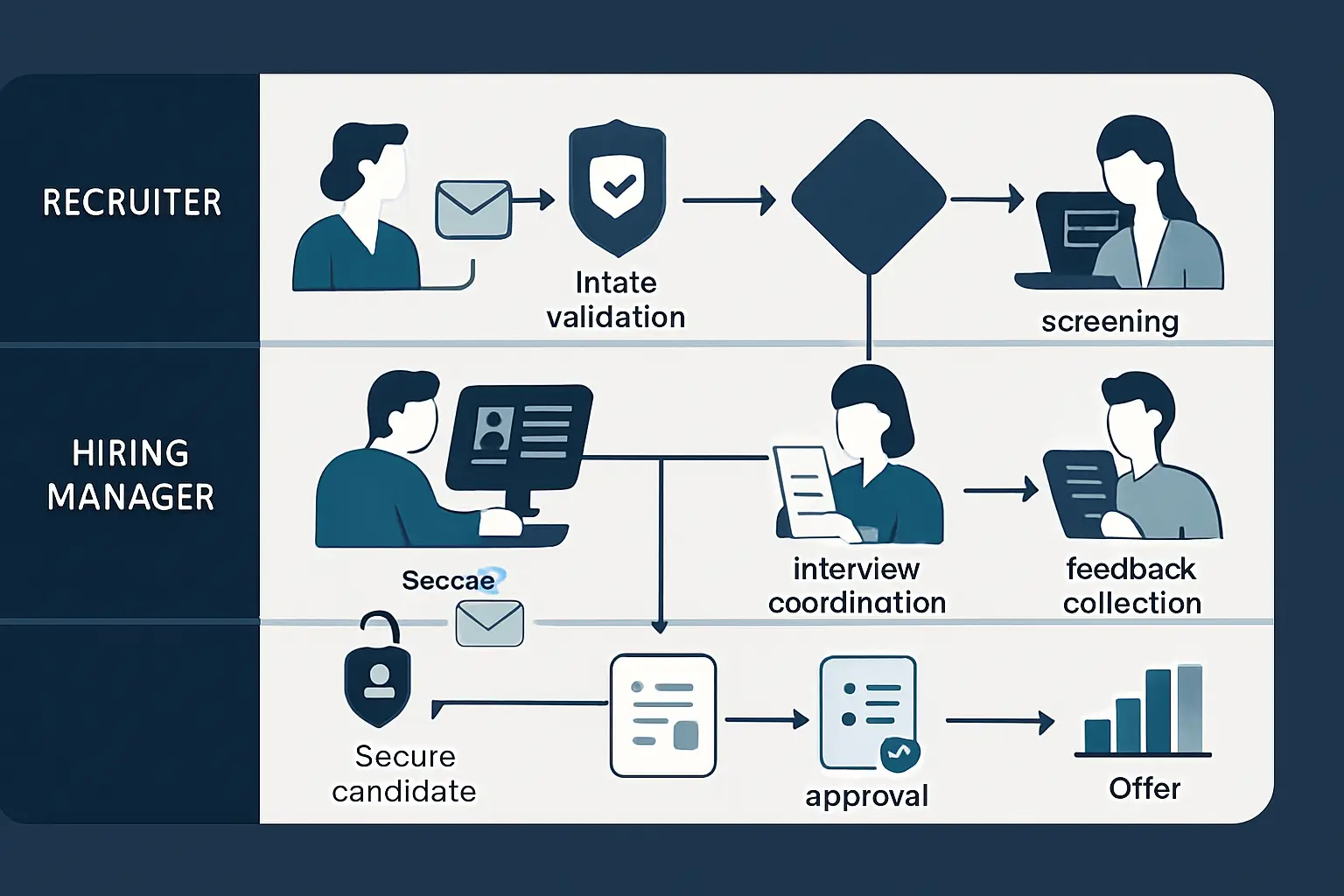
In practice, a recruitment workflow solution gives recruiters, hiring managers, interviewers, approvers, and candidates a shared route through hiring. Instead of relying on inboxes, spreadsheets, and informal follow-ups, it defines what happens after an application arrives, who owns the next action, when escalation is needed, and which evidence must be retained. As a result, teams can reduce avoidable waiting while keeping selection decisions with accountable people.
The most useful recruitment workflow solution combines practical process rules with the right level of automation. In addition, workflow automation services can coordinate recurring tasks and notifications, while API integration automation can connect recruitment records with calendars, assessments, HR platforms, and reporting tools. Ultimately, the result should be a clearer hiring operation, not an impersonal automated funnel.
Key Takeaways
- Map the candidate journey
First, a recruitment workflow solution should map a candidate's movement from application to offer outcome, including handoffs and exceptions between those points.
- Automate coordination
Use automation for assignments, reminders, status updates, scheduling, templates, and evidence capture; however, retain human judgement for selection decisions.
- Make ownership explicit
In practice, every material stage needs an accountable owner, a response expectation, a decision rule, and an escalation route.
- Measure waiting time
Consequently, stage timestamps and ageing views can reveal whether applications, feedback, approvals, or communications are causing hiring delays.
Where a Recruitment Automation Workflow Breaks Down
A recruitment workflow solution reveals that persistent delays usually occur at handoffs rather than within a single recruiter task.
Recruitment Automation Workflow Intake Gaps
When sources provide different information, recruiters must find basics before a meaningful first review. For example, applications can arrive through careers pages, job boards, referrals, email, and agencies.
- Inconsistent required fields
- Duplicate candidate records
- Missing consent or source details
Hiring Workflow Solution Review Delays
A recruiter may identify suitable candidates, yet manager feedback can remain in an inbox without a deadline, decision form, or agreed delegate. Therefore, a visible review task is more reliable than an informal request.
- No visible review owner
- Undefined response expectation
- Late shortlist decisions
Candidate Recruitment Workflow Communication Gaps
Candidates can experience silence when interview feedback, requisition changes, and recruiter communication are disconnected. Consequently, routine messages may be missed or sent before the underlying decision is confirmed.
- Unacknowledged applications
- Unclear next steps
- Inconsistent status messages
Recruitment Workflow Solution: Core Hiring Stages
Although the route may vary by role, location, and policy, the core stages, exit criteria, and evidence requirements should be clear.
- 1
Candidate Intake in the Recruitment Workflow
First, create or match a candidate record, associate it with the correct requisition, capture the source, acknowledge receipt, and flag missing essential information. Therefore, do this without requesting unnecessary data.
Complete candidate profile linked to an open requisition - 2
Recruitment Workflow Screening
Review job-related baseline requirements such as location, work eligibility, availability, minimum qualifications, and role-specific criteria. However, ambiguous information should go to a recruiter review route rather than an automatic rejection.
Recorded screening outcome and rationale - 3
Hiring Workflow Solution: Manager Review
In practice, present a consistent candidate summary and request one defined action: progress, decline, hold, or request clarification. Once a due date is set, automated reminders can support the process.
Time-stamped hiring manager decision - 4
Hiring Workflow Solution: Interview Coordination
Meanwhile, confirm format, panel members, candidate availability, time zones, meeting details, preparation material, and any accommodations. A separate rescheduling path prevents changes from disrupting the main route.
Confirmed interview event and notifications - 5
Recruitment Workflow Feedback Calibration
Prompt interviewers to submit structured scorecards promptly. If feedback is incomplete, conflicting, or raises a concern, route the case to a recruiter-led discussion before selection progresses.
Consolidated interview assessment - 6
Hiring Workflow Offer and Closure
Route selection, compensation, headcount, and other required approvals separately from interview feedback. Then, once authorized, issue the appropriate communication, record the response, and close or retain records according to policy.
Offer outcome and retained recruitment evidence
A recruitment workflow solution should coordinate information between people and systems without hiding decisions that require review.
- Application source First, a careers page, referral, agency, or job board submits candidate information.
- Candidate record Then, the ATS or central recruitment system creates, matches, and stores the governed record.
- Recruiter review Next, a recruiter interprets eligibility, experience, missing information, and exceptions.
- Manager decision Afterward, the hiring manager progresses, declines, holds, or asks for clarification.
- Interview operations Meanwhile, calendar tools, meeting services, scorecards, and notifications support coordination.
- Offer and handoff Finally, authorized approvals trigger offer actions and a controlled HR onboarding handoff.
Recruitment Workflow Automation Use Cases
A recruitment workflow solution is best introduced through repeatable coordination with frequent assignments, reminders, and standard communications.
Recruitment Workflow Intake Routing
Applications from different channels can contain inconsistent fields, duplicates, or no clear requisition owner, delaying first review.
Use guided forms, duplicate checks, source capture, acknowledgement messages, and routing rules that place each record into the correct recruiter queue or talent pool.
- More complete candidate records
- Less manual copy-and-paste work
- Clearer ownership from the start
Hiring Workflow Manager Follow-up
Suitable applicants can wait when manager requests have no deadline, decision choices, or escalation route.
Create a structured review task with a candidate summary, due date, reminder schedule, and an authorized delegate or escalation path for overdue responses.
- Visible review status
- More consistent decision records
- Reduced candidate waiting time
Hiring Workflow Feedback Capture
Interview feedback may arrive late, vary in format, or be missing when a selection decision is needed.
Send role-specific scorecards after interviews, identify incomplete responses, and block final selection until required feedback or an approved exception is recorded.
- More complete assessment evidence
- Clearer follow-up actions
- Improved auditability of decisions
Hiring Workflow Solution Roles and Decision Rights
A recruitment workflow solution can coordinate work; however, it cannot resolve unclear authority, undefined assessment criteria, or unowned exceptions.
Recruitment workflow screening
- Recruiter responsibility
- Review applications, request clarification, assess baseline suitability, and record the outcome.
- Hiring manager responsibility
- Meanwhile, clarify role-specific essentials when standard criteria do not resolve a case.
- Workflow control
- Use approved disposition reasons and retain a manual review path for ambiguous applications.
Hiring workflow shortlist review
- Recruiter responsibility
- Prepare concise candidate summaries, route profiles, and follow up on overdue decisions.
- Hiring manager responsibility
- Select progress, decline, hold, or request more information by the agreed deadline.
- Workflow control
- Therefore, assign an accountable owner, due date, reminders, and a documented delegate route.
Interview assessment workflow
- Recruiter responsibility
- Coordinate logistics, monitor attendance, and identify missing scorecards or conflicting feedback.
- Hiring manager responsibility
- Attend or assign interviewers, submit evidence-based feedback, and identify concerns for discussion.
- Workflow control
- Require complete feedback or an approved exception before final selection can move forward.
Hiring workflow offer authorization
- Recruiter responsibility
- Compile selection evidence, prepare the offer request, and issue approved communications.
- Hiring manager responsibility
- Recommend the selected candidate based on the agreed assessment process and business need.
- Workflow control
- In addition, route financial, headcount, and policy approvals separately from the interview decision.
Candidate Communication in the Candidate Recruitment Workflow
Candidate communication should be part of the operating design rather than a task completed only when a recruiter has spare time.
Automate predictable messages
Some communications are repeatable when they follow a verified status change. For example, application acknowledgements, interview confirmations, task reminders, rescheduling notices, and next-step instructions can use approved templates and monitored reply routes.
- Trigger messages only after the status is confirmed
- Use location- and role-appropriate templates
- Keep a clear record of meaningful communications
Keep sensitive situations human
Consequently, recruiters or authorized staff should own detailed role questions, accessibility requests, complex scheduling issues, offer negotiations, feedback requests, and circumstances that need empathy or context. Instead, the workflow should flag these cases rather than send a generic response.
- Route sensitive requests to authorized staff
- Avoid automated promises about outcomes
- Give candidates a clear way to ask for help
Technology for a Hiring Workflow Solution
The right approach depends on hiring volume, existing platforms, security requirements, regional obligations, reporting needs, support capacity, and budget.
Applicant tracking system
An ATS commonly provides the central candidate record, requisition management, disposition history, communications, and reporting. In addition, before adding tools, assess whether its native workflow functions support the required stages.
Recruitment workflow orchestration layer
A low-code, cloud, or custom workflow service can coordinate reminders, approvals, notifications, document requests, and cross-system updates when the core platform is insufficient. Its rules should reflect agreed process ownership.
Workflow automation servicesCalendar and meeting tools
Calendar connections can support availability, invitations, meeting links, interviewer reminders, and rescheduling. However, access should be limited to information needed for scheduling.
HR and identity systems
After offer acceptance, approved information may move into onboarding, employee records, identity provisioning, payroll, or learning systems. Consequently, define the authoritative system at every handoff.
Assessment providers
Assessment, reference, and background-check services may supply status updates through secure integrations. The workflow should retain consent, supplier status, exceptions, and completion evidence without exposing unnecessary data.
Reporting and analytics
A governed reporting layer can combine stage timestamps, workload, source quality, and approval delays. It should use defined metrics and access controls rather than informal spreadsheet extracts.
Reporting automation guideThe recruitment platform should remain the central record unless a documented design assigns another system that responsibility.
- Candidate sources First, connect careers sites, job boards, agencies, referrals, and internal applications.
- Central recruitment record The central record holds candidate profiles, requisitions, stage history, communications, consent, and disposition.
- Workflow orchestration Meanwhile, orchestration manages assignments, reminders, approvals, exception paths, status checks, and audit events.
- Interview tools Calendar and meeting tools support availability, scorecards, and interviewer notifications.
- External providers Where appropriate, external services provide assessment, reference-check, and background-screening status.
- Downstream HR systems Finally, controlled data can move to onboarding, HR records, payroll, identity, and business reporting.
Recruitment Process Automation Governance Controls
Because candidate information is sensitive and recruitment decisions can have significant consequences, controls belong in the workflow design from the beginning.
Recruitment workflow automation and proportionate information
Collect only the information needed at the relevant stage. For example, a first-stage application may need contact details, work location, availability, and evidence against stated essential criteria. It may not need every onboarding detail before a recruiter decides whether a candidate should progress. As a result, data minimisation can reduce candidate friction while limiting unnecessary exposure.
Explainable recruitment workflow automation rules
Where automation assists with routing or completeness checks, document the job-related rule, the data it uses, and the expected outcome. In particular, avoid treating uncertain or incomplete information as a final decision. A recruiter should be able to review exceptions, explain the process, and correct a record when appropriate.
Hiring workflow access, retention, and audit history
Accordingly, apply role-based access to candidate records, attachments, interview feedback, and approval data. Additionally, define retention schedules, secure document handling, deletion or anonymisation processes where appropriate, and audit logs for material status changes. Privacy obligations differ by jurisdiction, so organizations should obtain suitable legal and HR guidance for their circumstances.
Implementing a Hiring Workflow: Checklist
A recruitment workflow solution works best when operating rules are agreed before automation is configured.
- Map the actual journey
First, document real entry points, status changes, approvals, interview routes, systems, communications, and handoffs rather than relying only on policy.
- Define stage exit criteria
Specify what must be true before a candidate can progress, be held, declined, offered, or moved into a retained talent pool.
- Assign accountable owners
In particular, name the recruiter, hiring manager, interviewer, approver, delegate, and escalation owner for each material stage.
- Agree exception routes
Plan for duplicates, withdrawals, internal candidates, absent interviewers, accommodations, urgent hiring, role cancellations, and incomplete information.
- Set communication rules
Then identify automated messages, those requiring recruiter review, reply monitoring, and the owner of template approval.
- Protect candidate data
Apply access controls, retention rules, consent-related controls, secure attachment handling, and audit logging appropriate to the organization.
- Test realistic scenarios
Before launch, test normal hiring, delayed feedback, rescheduling, failed integrations, rejected approvals, withdrawals, and requisition closure.
- Train process owners
Train recruiters, managers, interviewers, and approvers on statuses, decision records, escalation routes, and support contacts.
- Review after launch
Finally, use workflow data and user feedback to identify unnecessary fields, bottlenecks, unclear statuses, and integrations requiring refinement.
Hiring Workflow Solution Metrics for Identifying Delays
Importantly, a recruitment workflow solution should reveal where work stops moving, not simply produce a high-level time-to-hire number.
Recruitment workflow stage timing
Measure the time from application to initial review, shortlist to manager response, interview completion to feedback submission, selection to approval, and approved offer to candidate response. In practice, these intervals help reveal whether a delay sits with intake, stakeholder availability, interview operations, or internal authorization.
Hiring workflow ageing views
An ageing report shows open applications, pending manager reviews, incomplete scorecards, and unapproved offers by how long they have waited. Therefore, teams can intervene while candidates are still active rather than discovering the issue only in a monthly report.
Recruitment workflow quality alongside speed
A faster route is not necessarily a better route. In addition, monitor incomplete feedback, reopened requisitions, frequent manual status corrections, candidate withdrawals, overdue communications, and exception volumes. Together, these indicators can show whether the workflow is usable and controlled, rather than merely fast.
When data is spread across platforms, automated reporting and dashboard automation can help consolidate governed operational views without relying on recurring manual exports.
Build a Reliable Hiring Workflow
The strongest workflows make progress, ownership, and evidence visible without reducing recruitment to an inflexible sequence of automated rules.
A well-designed recruitment workflow solution gives every participant a clear next action while preserving appropriate human judgement. It connects candidate records, recruiter reviews, manager decisions, interview coordination, approvals, communications, and reporting through consistent rules rather than informal follow-up.
Therefore, begin with the points where candidates or decisions wait. Then define the stage criteria, accountable owners, exception routes, and data controls before configuring automation. Ultimately, use workflow technology and integrations to make repeatable coordination dependable, measurable, and easier to improve over time.
A reliable recruitment workflow solution begins with a clear process boundary, accountable owners, and visible exception handling. Test it with realistic data, document support responsibilities, and review operating evidence after launch before expanding the design.
A reliable recruitment workflow solution begins with a clear process boundary, accountable owners and visible exception handling.
Test it with realistic data, document support responsibilities and review operating evidence after launch before expanding the design.
Frequently Asked Questions About the Candidate Hiring Workflow
These answers address common decisions teams face when planning recruitment process automation.
In other words, a recruitment workflow solution is a defined process and supporting technology that coordinates candidate intake, screening, reviews, interviews, approvals, communications, and recruitment records. It makes ownership, stage criteria, and exceptions visible across the hiring journey.
Recruitment automation is well suited to repetitive coordination such as record creation, routing, reminders, scheduling notifications, document requests, status changes, and reporting updates. However, human owners should remain responsible for interpreting evidence, making selection decisions, handling sensitive requests, and approving offers.
Yes. Many organizations retain their ATS as the central recruitment record and add integrations or a workflow layer for calendar coordination, approval routing, notifications, assessment status updates, and reporting. Consequently, the design should clearly identify the authoritative system for each type of data.
They can support timely acknowledgements, consistent interview details, visible ownership of next actions, fewer missed follow-ups, and clearer updates when a verified stage changes. However, candidates still need access to a person when their situation requires context, support, or discretion.
Useful measures include time between stages, ageing of active reviews, feedback completion, approval turnaround, candidate withdrawal patterns, overdue communications, exception volumes, and manual status corrections. Review quality indicators alongside speed so that a shorter process does not compromise fair and informed decisions.
Custom development may be appropriate when an organization has unique approval rules, complex regional requirements, proprietary assessment journeys, multiple disconnected systems, or needs a unified experience beyond what standard tools can provide. In practice, the decision should consider maintainability, security, support, scalability, and integration requirements.
Need Help With Your Hiring Workflow?
Build a practical approach around your existing systems, hiring policies, and operational priorities.
JiyanaTech can assess your current recruitment workflow solution process and design a maintainable automation solution around your systems, controls, integrations, security and support needs.
Discuss This Workflow